

How to Use Ball-Tooth Drill Bits
Release date:
2022-03-25
Author:
Source:
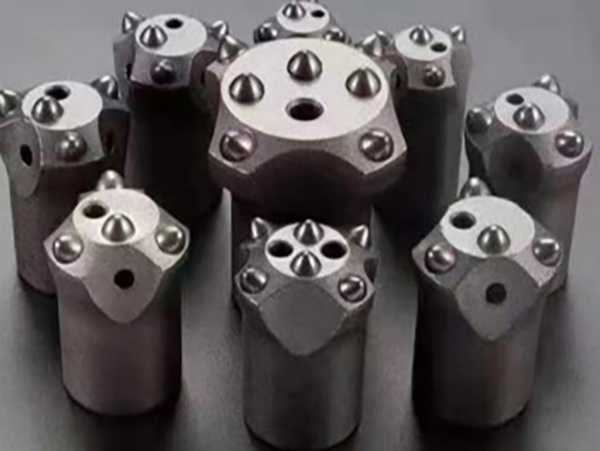
To ensure proper use of the ball-tooth drill bit and to maintain its normal wear and eventual replacement, please note the following points:
1. Select the drill bit based on rock conditions (hardness, corrosiveness), drilling methods (surface, underground, tunneling drills, production drills, anchor hole drills), cuttings removal media (compressed air, high-pressure water), and rock drills (heavy-duty, lightweight, pneumatic, hydraulic). Different tooth arrangements and cuttings removal systems are suited to different job sites. Choosing the right drill bit is essential for achieving maximum drilling speed. 。
2. When drilling, maintain stability and ensure that the rock drill's operating parameters are lowered to prevent excessive load on a single tooth, which could lead to chipping or tooth loss.
3. Based on the drilling conditions, promptly adjust the rock drill's operating parameters—specifically impact, thrust, and rotation—to ensure that the drill bit does not jam, drilling speed remains high, and the drill rod stays straight. Alternatively, you can assess the situation by measuring the temperature of the connection sleeve between the drill bit shank and the drill rod: under normal water-cooled dust removal conditions, the temperature should be ≤40°C; while under compressed air–assisted dust removal, it should remain ≤70°C.
Note: When using the drill bit, never stop the water or gas supply—otherwise, the bit is highly likely to overheat, leading to chipping, tooth loss, and ultimately, failure.
4. After a certain period of operation, the carbide teeth and casing of the button bit should be regularly inspected for wear. If significant wear is detected on either the carbide teeth or the casing, they should be promptly resharpened using appropriate tools to avoid compromising drilling speed and preventing issues such as reverse tapering that could lead to bit jamming. In cases of severe wear on both the carbide teeth and casing, to prevent tooth loss or breakage of the bit body—both of which could result in wasted holes—it is essential to replace the bit with a new one without delay.
Related News
What are the advantages of carbide threaded drill bits?
2025-09-20
How to effectively improve the surface precision of workpieces?
2022-07-05
Things to keep in mind when using carbide hob cutters!
2022-07-05

Sireep
WeChat QR code
Service hotline:+86-731-22590305
Email:eva.ling@sruipu.com
Address: Building 6-B, Power Components Industrial Park, Xinma Innovation & Self-Reliance Park, Tianyuan District, Zhuzhou City, Hunan Province
tel:
E-mail:
在线客服添加返回顶部
启用全局默认滚动动画 (向上滚动)
右侧在线客服样式 1,2,3 1
图片alt标题设置: Zhuzhou Sirepu Cemented Carbide Co., Ltd.
表单验证提示文本: The content cannot be empty!
循环体没有内容时: Sorry, no matching content was found.
CSS / JS 文件放置地